Anniversary Mass for the Feast of St. Alban
“A Catholic church at Pontypool had been unknown since the Reformation. Catholics celebrated Mass in a back room of the Crown Hotel in Pontypool town.
Under the direction of the talented architect, J.J. Scoles the church was built and officially opened on 23rd July 1846. High Mass was celebrated by the Right Reverend Dr. Brown, Bishop of the Welsh District, assisted by a considerable number of Catholic clergy who formed a beautiful procession around the church and up the aisle.”
(Momouthshire Beacon, 1846)
The Vigil Mass for the Feast of St. Alban was celebrated by Archbishop Mark O’Toole, Cardiff-Menevia. We were asked to remember all those gone before us who had worshipped, served and prayed within these walls over the years and to ask for God’s continued blessing as we look forward to the future in hope.
As in 1846 the Catholic Clergy, led by Archbishop Mark O’Toole, processed into the church as such. Canon Paul (Parish Priest), Canon Nicholas James (Monmouth), Father Daniel Stanton (Cwmbran), to the very fitting entrance hymn, ‘The Church’s One Foundation’. (Lyrics: Samuel John Stone (1839-1900), Music Samuel Sebastian Wesley (1810-1876)
The Mass was sung to the setting of ‘Christ the Saviour’.
We extend our sincere thanks to our talented organist, Craig Brown, whose skilful and inspiring accompaniment greatly enriched the celebration of the Mass, enhanced our worship and was deeply appreciated by all present.
The Liturgy of the Word began with a reading from the Prophet Ezekiel (47:1–2, 8–9, 12), followed by Psalm 46 (2–3, 5–6, 8–9).
The second reading was taken from St Paul’s Letter to the Romans (8:31–35, 37–39).
All then stood as the Gospel was acclaimed, Archbishop Mark proclaimed the Holy Gospel according to St John (12:24–26).
HOMILY
Archbishop Mark began his homily with highlighting the great desire of the people in the 19th Century to have a Catholic church of their own.
‘What we see in those early generations, most significantly local and migrant miners together with their families, who found here a life and a home, is that they also wanted to experience that “living water” of God’s love which flows from the sacramental life of the Church. They wanted a fitting and beautiful building in which to worship God and celebrate the Sacraments.
As we gather this evening for this important anniversary, we are blessed to be surrounded by the prayer of these generations, too.
We may well ask, “How can you measure success? How can you quantify grace?” It is true that a Church is a physical building. Made of stones and mortar, wood and tile. Think of the careful planning and preparation that went into designing and then building St. Alban’s.
Yet, thinking of these things, we very quickly realise what this building has held these past 180 years. We think of the thousands who were brought into the family of the church through Baptism, those who made their First Holy Communion, or who have come here week by week, day by day, to receive He who is the bread of life. We think of the many young people who have been confirmed and those received into full communion with the Catholic Church. We thank God for those who started out a life together in marriage from here. We remember poignantly those whose funerals were celebrated here and who were commended to the love of God on their final journey.
We are also aware of the silent witness of grace in those who received the sacrament of Penance. And of course, we give thanks to the ministry of the priests who served the parish these past 180 years, grateful for the sacramental life that they witness to, in order to help others grow in holiness.
So too we think of the numerous people who have come to the Church seeking an oasis in the desert life, seeking to know more deeply the truths that St.Paul reminds us of:
“neither death nor life, nor angels nor rulers, nor things present nor things to come, nor powers, nor height nor depth, nor anything else in all creation, will be able to separate us from the love of God in Christ Jesus our Lord” (Romans 8).
For a Church is not only for the celebration of the sacraments but a place where people come to name their sorrow and their joy. Where they visit with the Lord in the Blessed Sacrament or simply light a candle before the image of Our Blessed Lady. What a testimony to grace these walls could tell if they could speak. This life of grace cannot be captured on a spreadsheet. It cannot be tabulated in the annual account.
Yet all of this is part of our celebration this evening. What a joy it is to be in this House of God, mindful of the rich graces of these past years. What a wonderfully rich history is that of the parish and of this Church. We give thanks to God for all that this Church holds in the life of faith for us and for the parish, and we ask God’s blessing for the future.”
They wanted what the Psalmist proclaims, “The waters of a river give joy to God’s city, the holy place, the abode of the Most High”.
(+ Mark O’Toole. Archbishop of Cardiff-Menevia)
After the Creed the hymn, ‘Praise to the Lord, the Almighty, the King of Creation’(Joachim Neander 1860, translated by Catherine Winkworth, 1863) was sung during the offertory procession and thus began the Liturgy of the Eucharist.
During Holy Communion, the choir of St Alban’s High School, accompanied by their Head of Music, Paul Cook, gave a beautiful rendition of Dona Nobis Pacem (“Grant Us Peace”), adding a prayerful and reflective atmosphere to this sacred moment of the Mass.
Following the final blessing and dismissal, the clergy processed from the church to the stirring hymn Now Thank We All Our God (Martin Rinkart circa 1636 translated by Catherine Winkworth 1858).
As the joyful strains of this much-loved hymn filled the church, the congregation united in a fitting expression of thanksgiving, bringing the celebration to a reverent and uplifting conclusion.
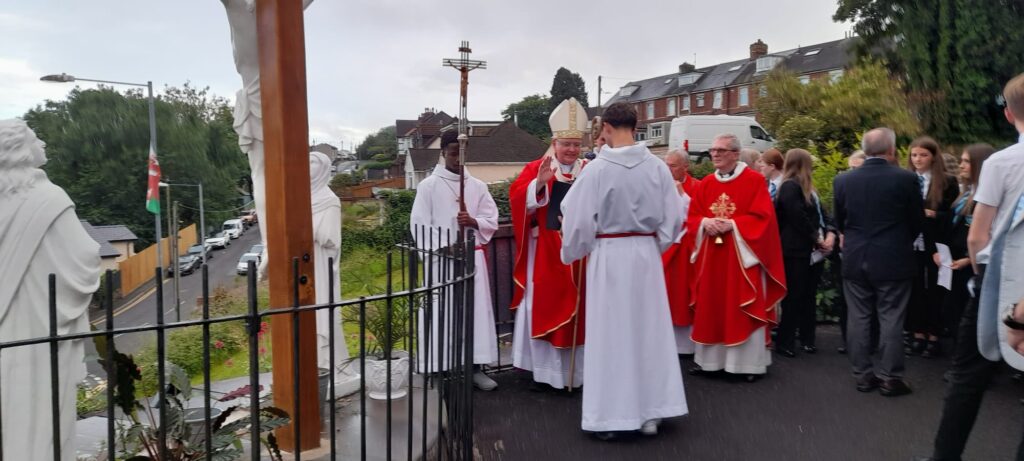
Following the Mass, the clergy and congregation processed to the church grounds, where Archbishop Mark solemnly blessed the newly restored crucifix while the choir from St. Alban’s High School sang, “Oh cross of Christ, immortal tree on which our Saviour died’.
Having been lovingly repaired and re-erected shortly before Christmas 2025, the crucifix now stands once again as a visible sign of faith, hope and Christ’s enduring presence within the parish and of the town of Pontypool.